Architecture overview
This page describes how the kLLM source tree is organized and how a command travels through it. It is the starting point for adding a model family, an engine, a recipe or a key source.
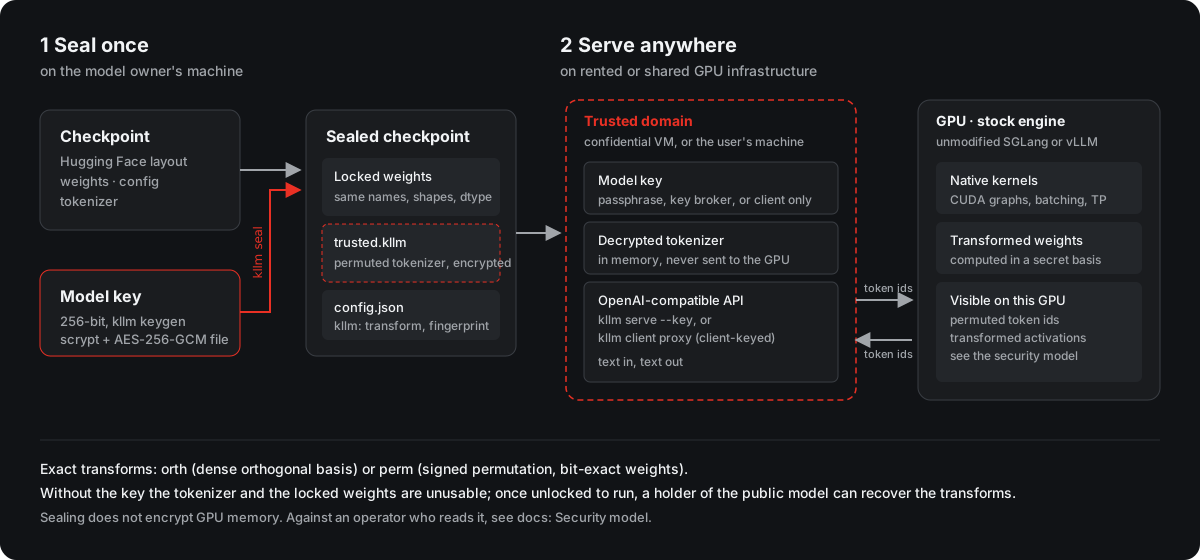
kLLM is a layer on top of the inference engine. It never runs a model itself: it rewrites checkpoints ahead of time and then starts a stock SGLang or vLLM process with the right arguments. Three layers do the work.
The provider layer owns keys and decides how a model is sealed and served.
The scheme layer holds the key-derived transforms and the sealed-checkpoint format.
The launch layer turns a description of a server into an engine command line and executes it.
Source layout
Path under |
Responsibility |
|---|---|
|
The |
|
|
|
The |
|
GPU inventory from |
|
The |
|
|
|
|
|
|
|
Key-derived permutations (Fisher-Yates driven by a ChaCha20 keystream). |
|
The decoder-LLM scheme: |
|
Names shared by the schemes ( |
|
Sealing and serving of MiniMax H3 pipelines. |
|
Client-keyed mode: the export of the cloud part, the user-side LLM client and proxy, the client-keyed Z-Image sealer, the keyless latent server and reply encryption. |
|
The keyed Z-Image scheme used by |
|
Key sources: the environment and plug-ins registered under the |
|
The user-side attestation binding check ( |
|
Optional INT8 kernels for the MiniMax H3 diffusion transformer and the
|
Dependencies follow the layers. cli.py, trust.py, gpu.py, recipes.py and
backends/ need only the standard library, so plain serving works without the keyed
extras. kllm.keyed needs cryptography (the keyed extra) and, for sealing and
serving sealed models, torch, safetensors and numpy (the seal extra).
The provider layer
kllm.trust.TrustProvider is a typing.Protocol. Its methods are the complete set of
operations the CLI needs:
Method |
Used by |
|---|---|
|
|
|
Every command that takes |
|
|
|
|
|
|
|
|
|
|
load_provider() imports kllm.keyed.provider.Provider directly; the provider is not a
plug-in. Provider.seal chooses the sealer from the checkpoint:
no
model_index.json: the decoder-LLM sealer inkllm.keyed.schemes.seal;model_index.jsonof a MiniMax H3 pipeline:kllm.keyed.h3;model_index.jsonwith--client: the client-keyed Z-Image sealer (kllm.keyed.client.zimage), which accepts only Z-Image pipelines;any other
model_index.json: the keyed Z-Image sealer ofkllm.keyed.d1.
Provider.prepare_serve reads the seal metadata, refuses a key whose fingerprint differs
from the recorded one, refuses client-keyed and unknown schemes, and for the l1 scheme
decrypts the permuted tokenizer into a 0700 directory under /dev/shm and records
its path in spec.tokenizer. The sealed weights are passed to the engine as they are.
The scheme layer
A scheme defines how tensors are rewritten and how a sealed directory is laid out. The
decoder-LLM scheme l1 is implemented by Transforms in
kllm/keyed/schemes/transforms.py:
Shape.from_configreads the model dimensions fromconfig.json.Transformsderives every permutation, sign, scale and orthogonal basis from the key on demand, per layer and per expert.Transforms.applyrewrites one canonical tensor by name;apply_fp8does the same for an FP8 weight and its scale. Writers into the residual stream are mapped by the residual transform, readers by its inverse.sealed_namegives the tensor’s name in the sealed checkpoint (experts move; every other name is unchanged).
kllm/keyed/schemes/seal.py validates the configuration (check_config), streams the
safetensors shards through Transforms, writes the permuted tokenizer into
trusted.kllm and adds a kllm section to config.json. The layout is described in
Sealed checkpoint format.
Every transform is exact in exact arithmetic. The tests compare the logits of a float64
reference forward of the plain and the sealed model to 1e-9; see
Adding a model family.
The launch layer
LaunchSpec in kllm/backends/launch.py is a plain description of one server: model,
tensor-parallel size, host, port, recipe, extra engine arguments, environment, engine, and
optionally a tokenizer path, a diffusion flag or a command of kLLM’s own. argv() renders
the command line in a fixed order: the engine’s base command, host and port, the recipe’s
arguments, then the user’s engine arguments, so that user arguments override the recipe.
merged_env() combines the current environment with the recipe’s and the spec’s
variables. exec_server() replaces the kllm process with the engine through
os.execvpe. See Adding an engine.
The request path of kllm serve
For kllm serve ./Qwen3-8B-sealed --key, cli.cmd_serve performs these steps:
Detect the GPUs with
gpu.detect().With
--engine sglangand without--no-recipe, look up a recipe withrecipes.find(model, gpu_family, name).Set the tensor-parallel size:
--tp, else the recipe’s, else the number of visible GPUs (at least 1).Build a
LaunchSpecwith the model, host, port, recipe and passthrough arguments.Apply production mode, then choose the mode:
--clientcallsprepare_client_serve;--key-source cdhcallsattested_keyandprepare_serve;--keyunlocks the key file and callsprepare_serve.With
--int8, add the INT8 kernel environment for a MiniMax H3 pipeline.Print the summary; with
--dry-run, printspec.render()and exit.Call
launch.exec_server(spec).
From that point the engine serves requests on its own. kLLM adds no process, proxy or hook
on the request path of an engine started by kllm serve; the only exception is the
optional INT8 hook for MiniMax H3. For a client-keyed Z-Image pipeline, kllm serve
starts kLLM’s own latent server (spec.command) instead of an engine.
Extension points
To add |
Change |
|---|---|
A decoder model family |
|
An engine |
|
A serving recipe |
|
A key source |
A separate package that registers an entry point in the |
The scope rule in CONTRIBUTING.md applies to all of them: a sealed checkpoint keeps
every tensor’s name, shape and dtype so that the engine runs its stock model class and
kernels. A change that needs engine patches or extra work per token is out of scope. See
Contributing to kLLM.
See also
Adding a model family, Adding an engine, Contributing a serving recipe and Registering a key source for each extension point.
Concepts for the terms used on this page.