Overview
Positioning
ANet4D is simulation infrastructure for collaborative embodied agents. It is built to study how teams of agents decide together where, when and how to sense and act in a dynamic real-world place: multi-UAV fleets today, and in the forward direction also unmanned ground vehicles (UGV), unmanned surface vessels (USV), ground robots, fixed sensors and software agents in one experiment. Experiments are meant to be reproducible and auditable, so that one team can rerun, inspect and replace each part of another team's setup.
Robot simulators usually start from the vehicle and give it a hand-built map; digital twins usually show a place but cannot run missions in it. ANet4D starts from the place: a captured or reconstructed point cloud becomes a versioned World, the environment field, the drone fleet and their agents all run on that World under one simulation clock, and a browser watches and operates it from anywhere. The whole chain is:
Reality → Reconstruction → World → Environment → Simulation → Agent
"4D" means three spatial dimensions plus time: drones, weather and the timeline share one simulation clock, so any moment can be paused, stepped, recorded and replayed.
Four design principles:
The World is the core. Capture, reconstruction and simulation converge on one World Package: geometry for physics and queries, a point cloud for display, semantics and no-fly zones, anchored to a real place.
The browser views the world, the server computes it. Physics, safety, planning, perception and environment run on a Linux server without a GPU; the browser only streams and draws.
The environment is a 4D field. Wind, turbulence, visibility and precipitation form one field E(x, y, z, t); the same numbers act on the airframes and paint the sky.
An entity is a Physical Agent. Each drone (the entity type delivered today) publishes what it can do; other agents discover it, request a quote and delegate tasks. Every flight command still passes the simulator's admission and safety checks.
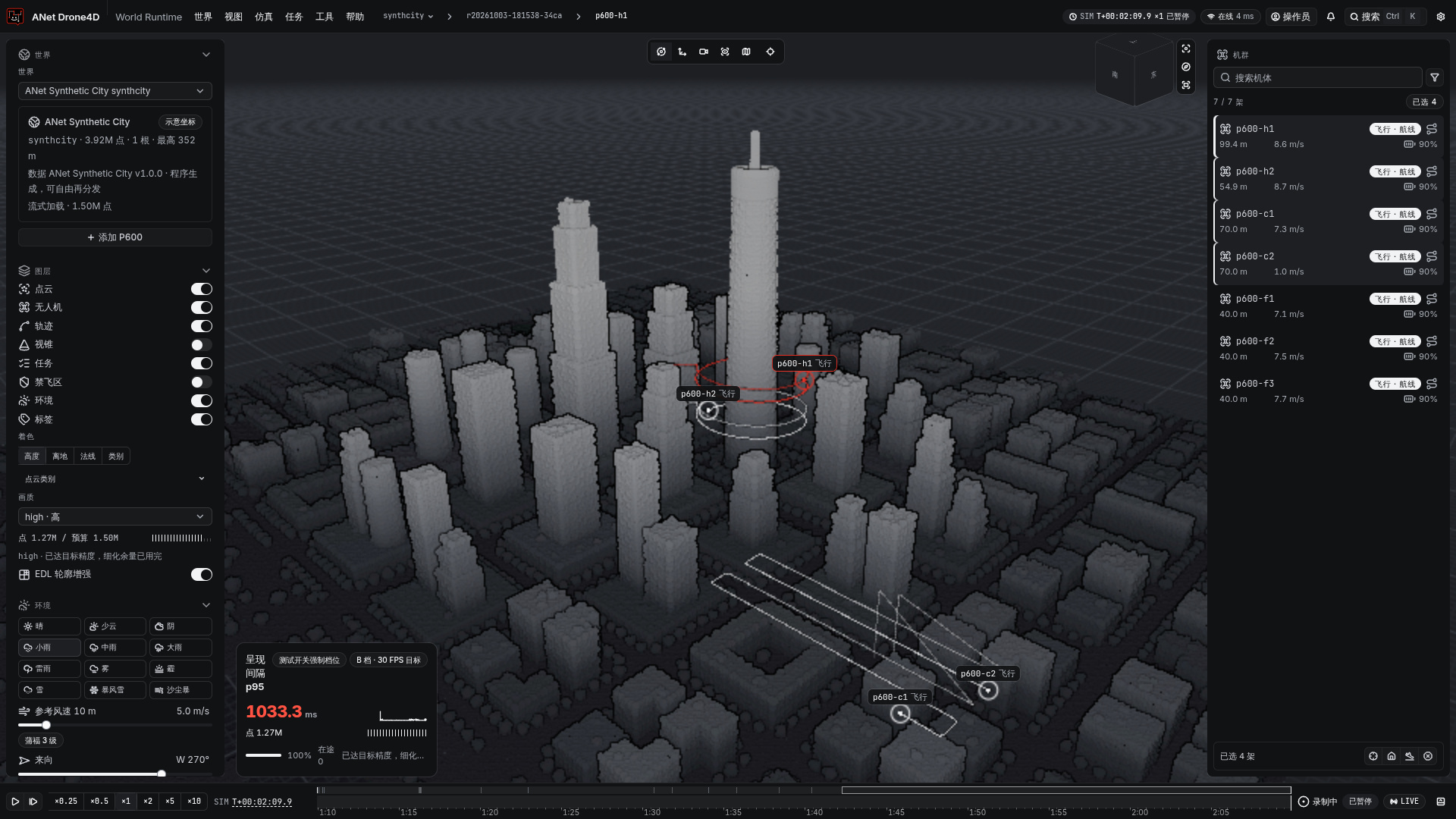
A real screenshot of V0.1 (D1) in the synthetic demo city ANet Synthetic City (an 8-core machine without a GPU, software rendering).
Current version
Item |
Content |
|---|---|
Version |
0.3.2 (V0.3.2 · ANet4D): the V0.3 Event Lab sealed with the tag v0.3.0 on 2026-10-25, the rename to ANet4D and the experimental scene-target foundations; each GitHub Release lists its known issues |
Public instance |
anet4d.agentnetwork.org.cn: the shared show, one sandbox per visitor and read-only Event Lab samples, no installation or sign-in |
Server |
Interactive Sandbox: Linux x86-64, Python 3.12, no GPU required; the public instance runs on a 4-core server without a GPU. Event Lab: Linux x86-64 with an NVIDIA GPU for sensor generation |
Browser |
Any desktop, tablet or phone browser with WebGL2; image quality and frame rate depend on the visitor's GPU |
License |
ANet Open Source License (a modified Apache-2.0), see Citation and license |
Capabilities and delivery status
Status labels:
Delivered: released in a version and accepted, or listed as a known issue.
In development: design finalized and scheduled in the current phase, with interfaces and acceptance criteria defined; not yet released.
Research: under evaluation or prototyping; whether it enters the product depends on the evaluation.
Capability |
Description |
Status |
|---|---|---|
World Package v1 |
Point cloud normalization (units, up axis, leveling, north, origin, normals, ground model), Potree 2.0 compatible octree with ANET_Q16 encoding, DSM and DTM, semantics and zones; |
Delivered V0.1 |
Seven worlds |
The synthetic demo city ANet Synthetic City and six UrbanScene3D cities (authorized by the dataset rights holders for this project's deployments) |
Delivered V0.1 / V0.2 |
City-scale point cloud streaming |
One Range request per octree root for the first screen; the APH selector and CAS controller regulate the point budget across 7 quality tiers in a closed loop |
Delivered V0.1 |
4D environment field |
Wind (height profile and turbulence), visibility and precipitation, 12 weather presets; simulation calendar, sun position, illuminance and wavelength-dependent extinction |
Delivered V0.1 / V0.2 |
Fleet on one clock (FleetSim) |
1 to 1,000 drones on a shared 250 Hz clock; PX4-style cascade compiled with numba; 1,000 drones stay real time on about half a CPU core |
Delivered V0.1 |
Safety and missions |
14-state flight FSM, geofence, energy-aware return to home, separation guard; 8 mission generators |
Delivered V0.1 |
Timeline, recording and replay |
Pause, step, rate ×0.25 to ×10; MCAP recording with byte-identical replay (local runs; not offered on the public instance) |
Delivered V0.1 |
Agent collaboration |
In-process Mock ANet: capability discovery, quotes, delegation and receipt verification (search and rescue scenario S3) |
Delivered V0.1 |
Interactive sandbox |
One isolated session and sim-core per visitor; admission, queueing, renewal, snapshots and world switching |
Delivered V0.2 |
Targets and perception quantification |
Six target classes with sensitivity ranges; detection, recognition and identification unified by the Johnson criteria and TTPF; per-pair perception readings and field views |
Delivered V0.2 |
Nests, tasking and relay |
Six task types and area guard, greedy allocator behind the Allocator interface, GSD scan planning, 7x24 relay monitoring and sustainability assessment |
Delivered V0.2 (short daytime relay gaps are a known issue) |
Open interface and Python SDK |
Sandbox REST v1, the |
Delivered V0.2 |
Airframe catalog |
The P600 digital twin (MID-360 configuration) and four generic reference airframes, including fixed-wing and VTOL |
Delivered V0.2 |
Startup, capacity and devices |
Startup screen with version and progress, queues for viewer seats and sandbox slots, power saving, phone and tablet layouts |
Delivered V0.2 |
Mesh worlds |
Photogrammetric GLB meshes with metric scale, true north and leveling calibration, and derived geometry, navigation and quality layers |
Delivered V0.3 |
Event simulation and active observation benchmark |
Compare the observations of different fleet policies under the same world and event; event DSL and event tape, evaluation and an internal leaderboard |
Delivered V0.3 |
High-fidelity physics tier |
The gz-sim lockstep tier as the physics tier for official scores; FleetSim stays as the fast tier |
Delivered V0.3 |
Sensor generation service |
Mesh rasterization cameras (RGB, depth, instance, semantics, rolling shutter, thermal), mesh LiDAR with the Livox MID-360 scan pattern, and IMU synthesis |
Delivered V0.3 |
Agent SDK and baselines |
The |
Delivered V0.3 |
Scene-target foundations |
Target appearance, activity and population bindings as additive optional contract fields; disabled by default and not offered on the public instance |
In development V0.3.2 |
Large-model command layer |
A large-model command layer through an inference gateway, and ANet multi-agent delegation (moved out of the V0.3 seal) |
Research D3.x / D4 |
3DGS appearance layer |
Gaussian appearance layer from mesh distillation and real aerial assets; the G-3DGS evaluation gate decides product entry |
Research D3.x / D4 |
Cross-entity collaborative experimentation |
Heterogeneous entities (UAV, UGV, USV, ground robots, fixed sensors, software agents) in one experiment; declarative experiment specifications, replaceable collaboration algorithms and a collaboration leaderboard |
Research D4 |
GPU reconstruction |
Reconstruction engines such as LingBot-Map, DA3-Streaming and MapAnything (the mock engine pipeline already runs end to end) |
Research V0.5 |
Real ANet network |
A self-hosted ANetHub, one daemon per drone, CBBA allocation under disconnection |
Research V1.0 |
Documentation map
You want to |
Start here |
|---|---|
Try it without installing |
The public instance, with Shared show and Sandbox |
Run it locally |
|
Control a sandbox from code |
|
Understand the internals |
|
Deploy your own instance |
|
Follow progress and quality |
The design documents are written in Chinese and live in the repository under docs/: the design baseline with 85 ADRs (docs/03), the D2 design supplement (docs/04), the D3 design supplement (docs/05), the module PRDs (docs/modules/) and the implementation and acceptance reports (docs/impl/). This site is written for users and summarizes the parts relevant to using the system; where the two differ, the design documents prevail.